Why Best Practices?
The Shortcut to Productivity and Results
James W. Cortada
What is a Best Practice?
What are "best practices"? The most widely held definition is that best practices are processes which are recognized as being the best by function or within an industry. For example, perhaps the best billing system in the world belongs to American Express. This company rarely bills you inaccurately; it also gives you more information than probably any other firm on what you charged on your card. In addition to that, it collects and analyzes that data as efficiently and effectively as any other company, thereby driving down administrative costs, finding new marketing opportunities, and linking card users with vendors who supply the services they most frequently charge. If I wanted to set up a credit card business or improve my billing process to customers, my first phone call would be to American Express. I would want to know how they bill, what it costs, how they manage the process, what they do with the data, and what are the economic benefits of the enormous investment they have made in the process. I would also like to know how they manage to be one step ahead of so many other billing operations in providing new services to its customers, merchants, and itself.
If I wanted to learn how to move things from one town to another and wanted to talk to the very best, I would turn to Federal Express, who is acknowledged as having the best practices in logistics. If I wanted to implement an employee suggestion process I would turn to Milliken. If I wanted to change my corporate culture in the direction of teams, I might turn to Delmarva Power, 3M or to Xerox, or to one of the Japanese companies, such as Toyota. Teams at 3M, for instance, made it possible for the company to maximize its use of R&D dollars by reusing ideas spread across many people.
The criteria for a best practice can range widely. Good public press for an organization's activities can excite your curiosity. Awards of excellence, such as that made by Beyond Computing, also helps. But today, the greatest majority of criteria emerge out of benchmarking studies, about which I will have more to say throughout this book. Best practices should not be confused with best product, however, since there is a difference. Federal Express does not produce a product, it does perform a service; the same with American Express. Toyota knows a great deal about teaming, but I am not always sure they have the best automobile. The U.S. Army may know more about inventory control and logistics than most corporations, and clearly has one of the great military organizations of the late twentieth century, but we do not think of them as producing a world class product—no war is. Yet we all saw how the U.S. armed services worked as a team to deliver vast quantities of supplies very quickly to the Middle East as part of the Persian Gulf War—certainly one of the greatest logistical victories of the second half of this century! You can have a great product and not have a best practice. A good indicator might be a great product that is way over-priced, that suggests the manufacturer or service provider has not figured out how to drive down costs. Many outstanding hotels are like this¾great service, too many employees running around, and your bill almost has to be presented to you on a flatbed truck. Best practices are collections of activities within an organization that are done very, very well and ultimately, are recognized as such by others.
Another concept to keep in mind is that a best practice is a case study suggesting better ways to do things. Such a case study—take American Express' billing¾then can serve as a base for benchmarking performance. Benchmarking helps you answer a variety of questions:
- What value do users place on this process or a proposed improvement?
- How effective does it have to be in order to make me competitive?
- How much opportunity exists for improvements in efficiency and effectiveness?
Best practices are rapidly becoming a way of improving cycle time. Industry in the past decade has come to recognize the full power of reducing the amount of time it takes to do things. Costs come down, customers are willing to pay for something done or delivered quicker, competition is strained, and improvements come earlier. But how do you achieve these benefits? There are a variety of proven techniques. One of them is to go find out how somebody else is doing something and then figure out how to transplant the best of the best practices in your organization in a way that make sense within your environment. This strategy applies to all departments in all organizations and across all industries.
In summary, best practices give you access to five sources of ideas for improving your operations:
- inspiration—because somebody else has already done it and it works
- benchmarking—because it provides a way to measure and analyze your effectiveness
- references—because these can become potential benchmarking partners and people to learn from
- skills transfer—because you do not have time to re-invent the wheel
- continuous improvement—because there is always opportunity to squeeze more productivity out of the work you do.
Is there such a thing as "bad practices?" It turns out that the answer is yes and that most people are guilty of practicing these until they learn better. It is very important to understand these because bad practices block your ability to get to best practices and frequently hide the fact that you are not doing things well. They hide things because on the surface they look terrific. The problem lies in their implementation. The five "bad practices" listed below are statements about bad implementation challenges, not necessarily about best practices that are really not the best. Remember the value comes from how you implement a best practice. This is even more important than finding one in the first place.
Bad Practice No. 1: Copy "as is." This is the act of literally reproducing in your organization how a process is done by somebody else. The problem with this "quick fix" strategy is that the reason the other person has made it into a best practices is because the practice was tailored to their specific needs, not yours. No two organizations have the exact same operating conditions, thus to utilize a "best practice" it has to be tuned to your particular circumstances. A common example is the wide adoption of employee suggestion or customer survey processes. If Company A, for instance, has a culture in which suggestions have rarely been taken seriously, you cannot just drop in Milliken's process. Milliken has a culture in which individual leadership on coming up with new ideas for improving efficiencies is celebrated and encouraged. So in Company A you probably would still have to pay for suggestions while at Milliken, it is recognized as part of everyday work.
Bad Practice No 2: No validation. You hear that some company has the best practice in a particular process and you rush over to see it, become enamored with it, and try to emulate it back in your organization without checking to see if it is, in fact, a best practice. You may, in fact, have a better practice to begin with. It is important, therefore, to have a set of criteria by which to determine what is a best practice so you know one when you see it and to measure it against your current practices. That means you have to understand in detail how well your current one functions and what are opportunities to improve them. To do that requires that you measure performance quantitatively and methodically. But more on that later in this book.
Bad Practice No. 3: Not current. Not everybody's best practice continues to remain best. To do that requires a process of continuous improvement and innovation and not everyone does that. Quite frequently some manager or executive will invest in a particular process for reasons unique to them at a particular time, but successor managers may not have the same interest or necessity to sustain the best practice. Meanwhile, people will have been writing articles and making presentations at conferences on their best practice, often presenting information that is one or more years old. To avoid this very common trap, you have to determine if the process you are looking at is the most current. Otherwise you may be attempting to model your own process against one that is not as efficient or effective as an already existing one. The owner of a well-run process will typically be a good source of information on how current his or her process is, usually because they are continuously benchmarking against other companies. Benchmarking results, therefore, are outstanding sets of evidence of currency.
Bad Practice No. 4: Relevance not established. This is another way of saying that the business value of implementing a best practice has not been established. We see this phenomenon with processes that are not linked to what the business is attempting to accomplish. It is a problem because implementing a best practice can consume substantial resources and time, so you might as well go through the effort for processes that can significantly enhance your organization's operations. Quality management experts frequently want to reengineer all processes. No. You do not have enough resources to do that so pick the ones that are most critical to your operations. Understand why they are critical to your success and how that success must be demonstrated through operational results. Then go forward and explore best practices, continuous improvement or reengineering.
Bad Practices No. 5: Done for fashion. Corporations and government agencies are as susceptible to fashion in management practices as teenagers are to fads in music and clothes. Let's face it, every several years there is a new management paradigm: Management by Objectives, Just-in-Time manufacturing, Total Quality Management, Agile Manufacturing, Business Transformation, and so on. Each has merit, but only if applied in ways that improve your organization. Common examples are everywhere: outsourcing of computer operations without having a good business case, advertising on the Internet without understanding what the Internet can do for you, PCs for executives when so many still can't even type. You still have to ask yourself a very basic question: how will a refurbished process that now is a best practice help my organization achieve its objectives? If you cannot properly answer that question and you still feel the impulse to go forward with the work, you may be guilty of succumbing to fashion.
Closely linked to the problem of fashion is politics. If yours is a culture in which careers are made by rapidly moving through jobs, then employees will feel a need to demonstrate the launching of an initiative during their watch. That calls for dramatic gestures that are seen as demonstrating action and results within the context of currently accepted (fashionable) management practices. There are two problems with this pattern of behavior: first, the person who started it may not have made the correct decision about what the organization really needed and second, will probably not be around to do the real hard work of getting the process working and continuously improved. Yet it is that latter phase of implementing a best practice where you get the real benefits and these activities are not glamorous or dramatically visible.
So we come to the issues of motivation and business case. Implementing best practices is hard work and expensive, but worth it. So you have to have a good reason for being interested in a best practice, let alone for building one yourself.
Role of Benchmarking
The strategy most frequently deployed for identifying and learning from best practices is the use of benchmarking. Two types are very evident in the best run organizations: function-based and process-based.
Traditionally, organizations have relied on measurement-based benchmarking to understand vendor performance, to conduct departmental audits, product testing, and cost measurements. Many organizations know how to do those things.
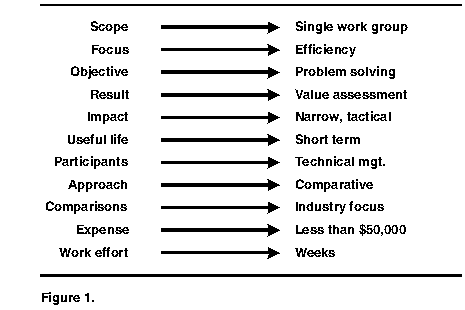
As Figure 1 illustrates, there are eleven characteristics that define measurement-based of benchmarking. Some are very obvious: the focus is on efficiency (i.e., cost), impact is narrow and tactical (i.e., uptime of a manufacturing machine, cost of information), and approach is comparative (i.e., one type of device to another, purchase vs. lease, my department vs. your department). These types of benchmarks are quite inexpensive (less than U.S. $50,000 in the 1990s). They are valuable for less than a year because technology and circumstances change. Most are conducted by management within a department or organization. These studies are not necessarily of limited value and, when well done, are useful for years.
Process-based benchmarking is used to understand how to exploit such things as technology or core competencies and special skills to improve the value of a process. You are using best practices to improve the value of a process. Here benchmarking becomes more complex, expensive, and the answers can be quite subtle. Yet this kind of benchmarking gets to the heart of best practices. It involves multiple departments and invariably makes it possible to fall into one of the "bad practices" traps if you are not careful. Figure 2 catalogs eleven characteristics evident in many organizations that conduct process benchmarking. As in Figure 1, the characteristics on the left are the same, but they play out differ on the right.
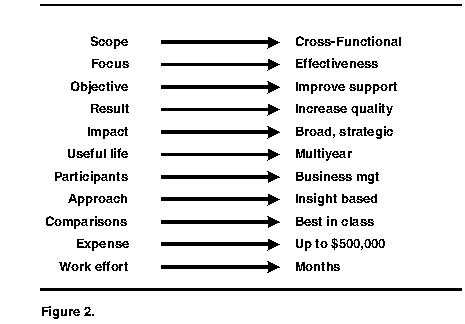
As with measurement-based benchmarking, well-run departments tend to demonstrate similar patterns of effective behavior. For example, process benchmarking is typically linked to broader business objectives, answering the question "How can we support the corporate objective through an improved process?" However, note that well-run organizations use benchmarking routinely to understand major issues: broad and strategic questions, hunt for the best in their industries, and are prepared to spend a great deal of money on these. If you can build a best practice, you can make a fortune. Federal Express demonstrated that with its logistics processes, American Express with its billing services.
A couple of other features of this approach are important to understand. They are insight based, which means management is looking less at how one mechanically does a task within a process—although that is important too—and more at the effects of the process on such issues as corporate culture, customer perceptions, productivity, ability to grow the business, improve quality, flexibility, and reduce wasted effort. To do this also requires that benchmarking be ongoing, for years in many cases, not a one-time event.
Best in Class vs. World Class, Which Is Best?
Since your ability to be competitive and always to arrive at a market early with an outstanding product or service is dependent on your organization's speed and capability of performing, minimum standards of performance and results have to be set. Just like there are best practices, there are sets of standards which emerge within one industry or across many industries. Let's make sure we are clear on what they are.
If you are trying to be best at something within your industry, we speak of that as attempting to be "best in class." This is particularly important in an industry where there are unique things going on, unique in that they do not necessarily appear in other industries. For example, transporting gas is almost entirely done exclusively within the utility industry. Performing this work the cheapest and providing it the most reliably would be a form of "best in class."
If you are trying to be very good, or best, at something that crosses industries, then we think of this as attempting to be "world class." For example, you and I know that customers judge service personnel based on experiences across all service industries. Thus, if we are used to not waiting in long lines to pay for goods at a small clothing store, we expect our supermarkets to do the same. If Hertz gets you into your rental car with no waiting, then waiting in line at a hotel to register becomes unacceptable. The hotel would have to become as good as Hertz—a member of a different industry—because we customers have developed an expectation for judging quality service.
Well-run companies that have best practices are very clear about which arena their practice must operate. These people can tell you quickly who they benchmark against—their industry or cross-industry—and why. The assumption is that world class is a higher standard than best in class and that the former is more expensive to reach than the latter. There is insufficient evidence to suggest if that is true. Companies care because one costs more; companies choose where to benchmark based on expected results. The point is, don't confuse the two.
What about your department? Don't we have to compare ourselves cross-industry since everyone who does what we do? Maybe. It all depends on what you are trying to do. Being world class for many people is like going to church or brushing your teeth everyday. Your mother taught you to do these things as a child in the belief that they were good for you. But as an adult, that is not enough. To really want to go to church and get the maximum benefit out of that experience requires that you have certain religious convictions. To brush your teeth everyday, you must appreciate the medical and social consequences of not brushing them, particularly as you get older and your teeth start getting looser! The same applies to you. Like brushing your teeth, doing things that make your operations world class, for example, can be done today in expectation of benefits tomorrow, like still having your teeth in five years.
If your organization, for example, needs to move from highly centralized to a decentralized model as part of a critical business strategy for the corporation, you probably would want to find the best practices for such a transformation regardless of industry, but always looking at what happened in your industry just to be on the safe side. On the other hand, if your organization needs to provide you with customer services unique to an industry (e.g., taking orders for stocks and bonds) you probably would limit your concerns to what other brokerage firms are doing. Yet even here, unique features can be very attractive. For example, Levis customer service processing system collects measurements on size of individual customers so that the company can make a pair of pants to order. It won't be long before its competitors will have to do the same thing, changing Levis "world class" process to a "given" in the industry. In short, the target keeps changing.
Best Practices as a Part of Business Transformation
Every major survey and published benchmark study done in the past several years has demonstrated that the best run organizations do not operate in relative isolation from the rest of the corporation or government agency. One of the driving forces behind these kinds of activities has been the continued expansion in the use of computers, now reaching close to 2 to 5 percent of most company budgets. Hard to believe, but there has been a concerted and often highly successful effort to link computers and their support staff more closely to mainstream business operations. Nothing has caused this situation to occur in a more compelling fashion than the growth in the size of information technology (I/T) budgets which in turn are driving the value issue. Process reengineering across corporations have also contributed to the discussion of value from I/T. While in the mid-1990s, we broadened the view of process work to take into account such other issues as corporate cultural and organizational considerations—hence terms like business transformation and learning organizations, among many, currently overtaking the phrase reengineering—it nonetheless is relevant for our immediate discussion.
One of the "best practices" that companies have increasingly strived for is effective redesign of critical operational processes. Process redesign has been going on for decades but in the late 1980s and early 1990s "process reengineering" was essentially rediscovered, made fashionable, and the thing to do. This was closely followed by press reports that 70 percent or more of reengineering projects were failing, which resulted in vast quantities of speculation pro and con. Brushing aside all that debate, what about the 30 percent or whatever the number is that were successful? One of the facts to keep in mind is that successful reengineering projects have very high I/T content. In other words, just simplifying a process, reducing levels of authorization and empowering front-line workers with authority to make decisions, or setting wild expectations born out of hype and sloppy thinking is not enough. The best redesigns exploit I/T to the fullest to capture and present information, analyze data, perform work previously done less cost effectively, and share operational responsibilities for the performance of processes across organizational boundaries both inside and outside your enterprise.
As a result, the I/T community in well-run organizations are very actively involved in staffing and guiding major process reengineering projects with very strong business executive sponsorship. For example, NIPSCO, a leading gas and electric utility company in the midwestern part of the United States, assigned responsibility for developing a whole new approach to servicing customer inquiries and billing to a senior executive who also happened to be a technologist. The answer he came up with involved designing and implementing a major customer service software application. Management fundamentally changed many things at NIPSCO: how and for what I/T was used, skills and responsibilities of customer contact employees, what NIPSCO's value proposition was in the market, and the culture of the company. The same story could be told about many other firms across multiple industries. But in each successful case, I/T personnel were intimately involved in the redesign and implementation of a new process. There is no published record of a best practice that does not have a heavy dose of I/T. Consequently, if you want to increase the odds of success in transforming your processes or your organization, the I/T community must be able to provide leadership and personnel to implement best practices.
Conclusion
Three points should be kept in mind about best practices. First, it is a strategy and a mindset for how to improve the efficiency and effectiveness of any organization. It crosses such bodies of management disciplines as accounting, quality management, virtual organizations, reengineering, and so forth, bringing order and clarity to our thinking about what to do. Closely tied to this point is the fact that best practices include customer focus while considering issues of efficiency and effectiveness. Second, it is a strategy that companies, consultants, and practitioners are beginning to talk about publicly, making it possible to collect insights on what are best practices. Third, it is almost if not always impossible to implement best practices today if your I/T organization does not participate.
In most large companies, best practices are being applied in various departments with or without conscious recognition by senior management. The quality management movement alone forced that change of behavior. These practices can be applied to fix immediate problems and improve operations right now, while guiding your transformation for the long term. The best at applying best practices do both. They know this year's operations need to improve and that they must be profitable. Best practices helps clearly in this arena. For more substantive changes that require multiple years or are true reengineering transformations, they give you a solid basis of what has worked, where things are going, and design points to encourage boldness and innovation in your thinking.
Copyright © 1997 by James W. Cortada. All rights reserved.
Madison, WI 53713-3414
phone: 608 273-3710
fax: 608 274-4554
Questions, comments, suggestions?
Email us! CWLPubEnt@execpc.com

Return to the CWL Quality Resources Page