
| SCATTERING from Micro-Rough Surfaces (RICE) |
Rice has formulated one of the most general solutions available for incoherent scattering cross sections from a slightly rough surface. The model is valid for both conducting and imperfectly conduction surfaces and preserves the polarization sensitivity of the scattering cross section. One of the virtures of this formulation is the ability to calculate a scattering profile directly from the surface roughness profile. Alternatively, a model power spectral denisty of the surface profile can be used as input to the scattering calculation. In-plane, out-of-plane scattering and the polarization dependence may all be obtained.
We now offer a summary of the basic results of the Rice formulation. The bidirectional reflectance distribution function (BRDF) is given by:
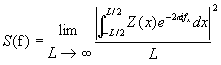
Where the incident angle, scattered angle and wavelength are ---- respectively. The power spectral density S(f) is a function of the spatial frequency f and is obtained from the Fourier transform of the surface roughness profile Z(x).
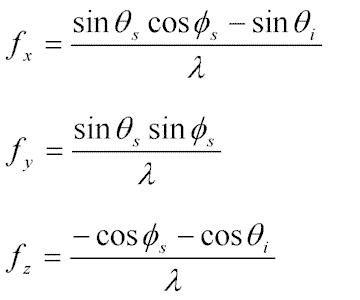
The components of the spatial frequency are given by the Bragg relations
The scattering matrix elements given using the Jones vectors in terms of the incident and reflected s- and p- components.
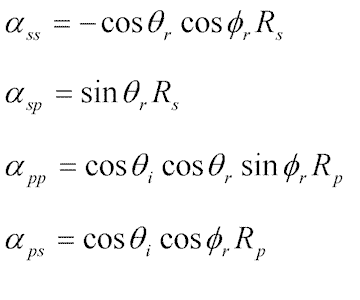
The reflectances Rs and Rp, are given by the Fresnel equations.
We have a full set theoretical and experimental tools for investigating the scattering of light from rough surfaces. Contact us today with your application.
[Home] [Optics and Photonics] [Surface Science] [Software] [Tutorials]
Send mail to rkbrandt@execpc.com with questions or comments
about this web site.
Copyright © 1999 Brandt Innovative Technologies, Inc.