| Al Lehnen |
| Mathematics Department |
| Madison Area Technical College |
| 3550 Anderson Street |
| Madison, WI 53704 |
| (608) 246-6567 |
| alehnen@matcmadison.edu |
| http://my.execpc.com/~aplehnen/al.htm |
Presented at the 73'rd Annual Sping Meeting of the MAA Wisconsin
Section
On Saturday, April 16, 2005
University of Wisconsin-Washington County
|
|
Abstract:
The branch of applied mathematics known as the "Calculus of Variations"
has its origins in the brachistochrone problem posed in 1696 by Johann Bernoulli.
The problem of the path taken by a "frictionless" bead accelerated from rest
by gravity that would minimize the time of transit is reviewed. A discussion
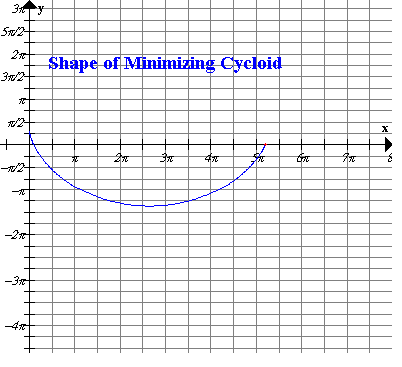
of the existence and uniqueness of the cycloid solution shows that if the
ratio of the horizontal distance traveled to the vertical distance traveled
exceeds  then the least time path will display an absolute minimum below the terminal
point of the trajectory. A complete asymptotic characterization of the solution
as a function of this ratio is given. Somewhat surprisingly, the key "technical
fact" required is the rather simple expansion of arccos(1-x) for small
x. Finally, several "trial" function trajectories are considered and
their ability to approximate the least-time cycloid is presented.
then the least time path will display an absolute minimum below the terminal
point of the trajectory. A complete asymptotic characterization of the solution
as a function of this ratio is given. Somewhat surprisingly, the key "technical
fact" required is the rather simple expansion of arccos(1-x) for small
x. Finally, several "trial" function trajectories are considered and
their ability to approximate the least-time cycloid is presented.
The text of the presentation is available at http://matcmadison.edu/alehnen/brach/brach.pdf
A parallel html version is at http://matcmadison.edu/alehnen/brach/brachchistochrone.html
The following Winplot files illustrate various topics from the presentation. Winplot itself can be downloaded at http://math.exeter.edu/rparris/winplot.html. An online tutorial is also available. To download a file, left click with the mouse and save the file to your local disk. Then you can open and view and/or manipulate the file in Winplot.